In-person tickets sold out! Please log on at the time of the event to enjoy our livestream.

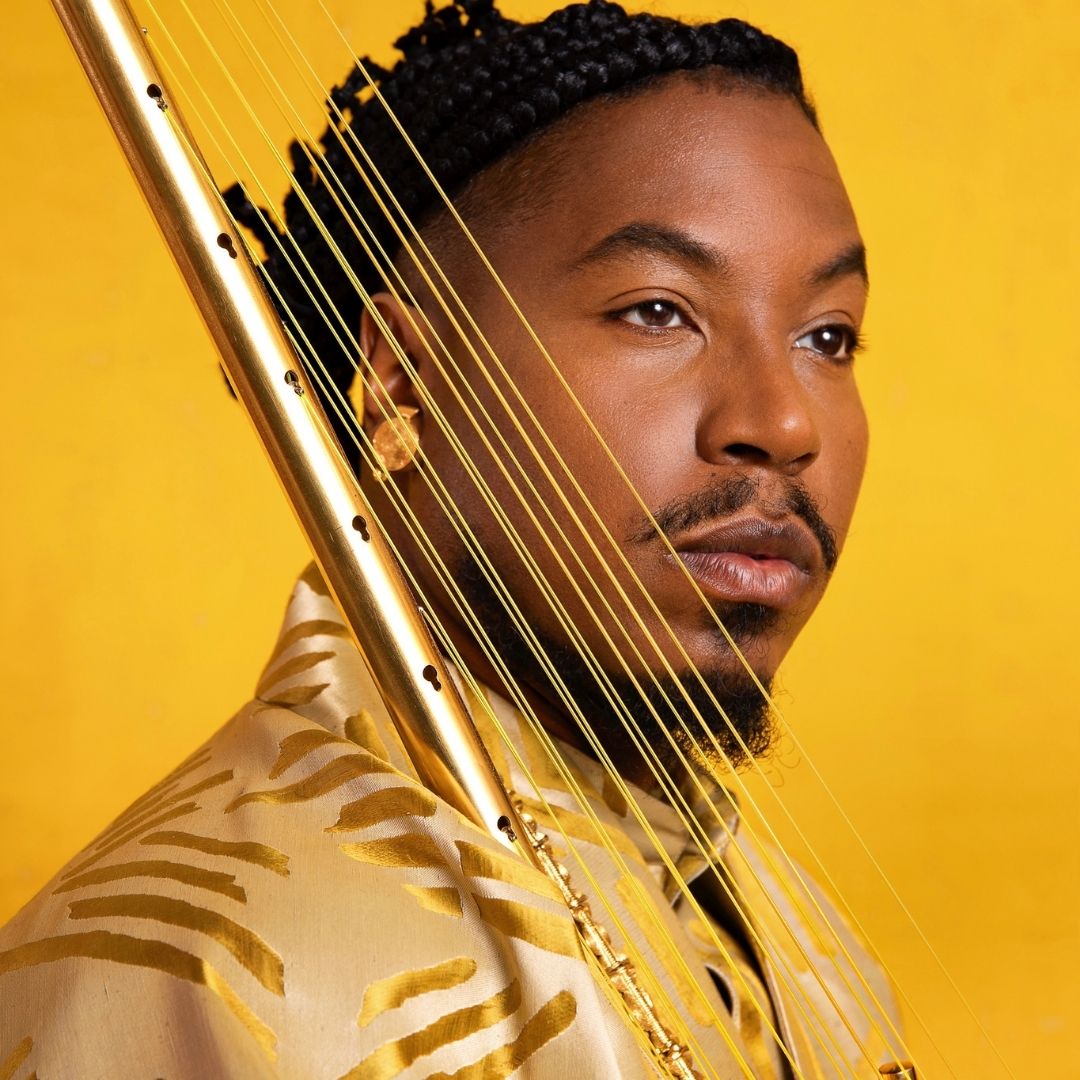
Chief Adjuah

“Since 2015, he has placed a new emphasis on patterned, polyrhythmic drumming, using a tightened-up approach and more explicitly melding the sounds of modern hip-hop with ancient, diasporic rhythms….”
— Giovanni Russonello review in The New York Times on Chief Adjuah’s album, Ancestral Recall

If you like what you hear, consider donating to the VJC to support our livestream programming.

Welcome to the Vermont Jazz Center. Tonight, we are extremely energized, feeling fortunate to once again welcome Chief Adjuah to our stage. He performed here in January of 2017 in a breathtaking show that included flutist Elena Pinderhughes. VPR Friday Night Jazz host Ray Vega once asked me to choose the concert held here at the Jazz Center that I found to be most significant, and Chief’s show in 2017 is the one that stood out for me. Along with the ensemble’s extremely high level of musicianship, there was a respectful blending of ancient traditions with modern grooves and an emphasis on rhythm. The group’s sound and lyricism were all unified by Chief’s vision as a leader and composer. For tonight’s performance, Chief Adjuah will be joined by two of the musicians who were with him that evening: Lawrence Fields on Fender Rhodes and keyboards and Kris Funn on bass. For this performance, we will also hear Cecil Alexander on guitar and Brian Richburg Jr. on drums and percussion. Tonight, we will experience a living journey that incorporates the urgent messages of today’s global unrest through the lens of Chief Adjuah’s wisdom and family history.

Chief Adjuah’s music celebrates the patriarchs and matriarchs of his family, whose lineage can be traced back to the New Orleans Maroons—enslaved people who escaped plantations to form independent communities in the swamps, forests, and marshlands around the city. The Maroons cultivated crops, hunted, created art, and traded with other Maroon communities. Many blended traditions with local indigenous peoples, giving rise to groups now known as “Black Indians” or “Mardi Gras Indians.” Though the Maroons were brutally suppressed, their legacy thrives in Chief Adjuah’s music and message, which gives voice to a people often ignored in history books. Their legacy lives on in the Black Masking Indian traditions that are still vibrant in New Orleans culture.

One of the noteworthy factors regarding Chief Adjuah is that he legally changed his name from Christian Scott to Chief Xian aTunde Adjuah. In doing so, Adjuah intentionally severed his lineage to the former colonists who enslaved his ancestors. Chief Xian aTunde Adjuah’s name honors his ancestry as a chief of the Xodakon nation, “a maroon society honoring Afroindigenous resistance and rebellion in the Americas since the 1700s.” Chief Adjuah’s family lineage is rooted deeply in New Orleans. He grew up in the Black Masking Indian tradition and followed his grandfather’s footsteps to become a Chieftain of the Xodokan Nation. His grandfather, Big Chief Donald Harrison Sr., led four nations: the Creole Wild West, White Eagles, Cherokee Braves, and Guardians of the Flame. In a 2025 interview with Tavis Smiley, Chief Adjuah said he was “born into a family of musicians – folk musicians and jazz musicians. The folk music from this tradition, some say, creates part of the beginning of jazz, so my introduction to the music is actually from the root music that created creative improvised music.”

Like fellow New Orleans native Nicholas Payton, Chief Adjuah considers the music he creates to be distinct from “jazz.” He considers the term “jazz” offensive and cites its use, especially in its early years, to be a parody of the authentic music that emerged in the United States, which was initiated by the African diaspora. Chief Adjuah instead calls his music “Stretch Music,” which is “genre blind” and “decolonizes the sound in a way that allows musicians from seemingly disparate cultural groups to enjoy their time together.” He says that, “Stretch Music fights for the very heart and soul of music, honoring the best of the past while stretching its possibilities into the future.

Chief Adjuah is also recognized as a “sonic architect.” His imagination has led to the creation of unique personalized instruments of his own design. For this visit, we will hear him perform on two trumpet-like instruments: a reverse flugel horn and a siren, and the Adjuah Bow, a 20-string harp that hybridizes the West African n’goni and the harp. He will also sing songs he composed that recall his ancestral memory as a descendant of the New Orleans Maroon community. His new instruments are either improvements over existing instruments (that enhance his concept and talent), or are re-imaginations of ancestral instruments that give him the comfort and tools to exist in a continuum with his ancestors.

Chief Adjuah grew up under the watchful eye of his uncle, Donald Harrison Jr. (who performed here in 2012 and 2017), a revered alto saxophonist and current Chief of Congo Square. Harrison tutored Adjuah in his early teens, training him in the “Nouveau Swing” style and the customs of tribal leadership. Touring with his uncle from age 14 to 20, Adjuah learned to approach music from an “ethnomusicological perspective, understanding the ancestral lineage of his instruments and repertoire.” He recalls, “When you learn the music from before it had labels, you learn the music from the perspectives of the Maroons, from the people who self-liberated…built their harps, and sang their songs from Senegal and Gambia and Benin, and Togo.”

After touring with Donald Harrison, Adjuah attended Berklee College of Music in 2002, launching his record label, debut album, and notable career. Since then, he has released thirteen studio albums, four live recordings, and a greatest hits collection. His collaborators include Prince, Thom Yorke, Mos Def, McCoy Tyner, Eddie Palmieri, Robert Glasper, Elena Pinderhughes, Logan Richardson, and Saul Williams. He is the founder of the Stretch Music App and Recording Company and has been recognized with six Grammy nominations, two Edison Awards, and a Doris Duke Artist Award. For this concert, Chief Adjuah will include music from his latest album, Bark Out Thunder Roar Out Lightning.

Chief Adjuah’s band: Pianist Lawrence Fields’ recording credits include works with Terri Lyne Carrington, Wynton Marsalis and Alvin Batiste, Joe Lovano, Jeff Watts and others. Baltimore bassist Kris Funn has performed worldwide with Chief Adjuah, Nicholas Payton, Sean Jones, and Pharoah Sanders, and serves on the jazz faculty at the Peabody Institute. Guitarist Cecil Alexander is a first-place winner of the Wilson Center Jazz Competition and the Lee Ritenour Six String Theory Competition and was a finalist in the Herbie Hancock Institute International Guitar Competition. He has performed and recorded with Bill Charlap, Antonio Hart, Luis Perdomo, and Steve LaSpina. New Orleans scion and Drummer, Brian Richburg Jr. can be heard on Julius Rodriguez’ album, Butterfly; he has toured with luminaries such as Nicholas Payton, Big Chief Donald Harrison Jr., Ellis Marsalis, Delfeayo Marsalis, Amina Figarova and Joanne Bracken.

This concert is sponsored by Dave Snyder of Guilford Sound, one of the finest studios in the country. Guilford Sound has been a long-time supporter of the Jazz Center. Their generous contributions are what make our concerts affordable for all. VJC is also grateful for ongoing support from the Vermont Arts Council and the National Endowment for the Arts. The Brattleboro Reformer and the Commons for underwriting VJC publicity.

– Eugene Uman, VJC Director